
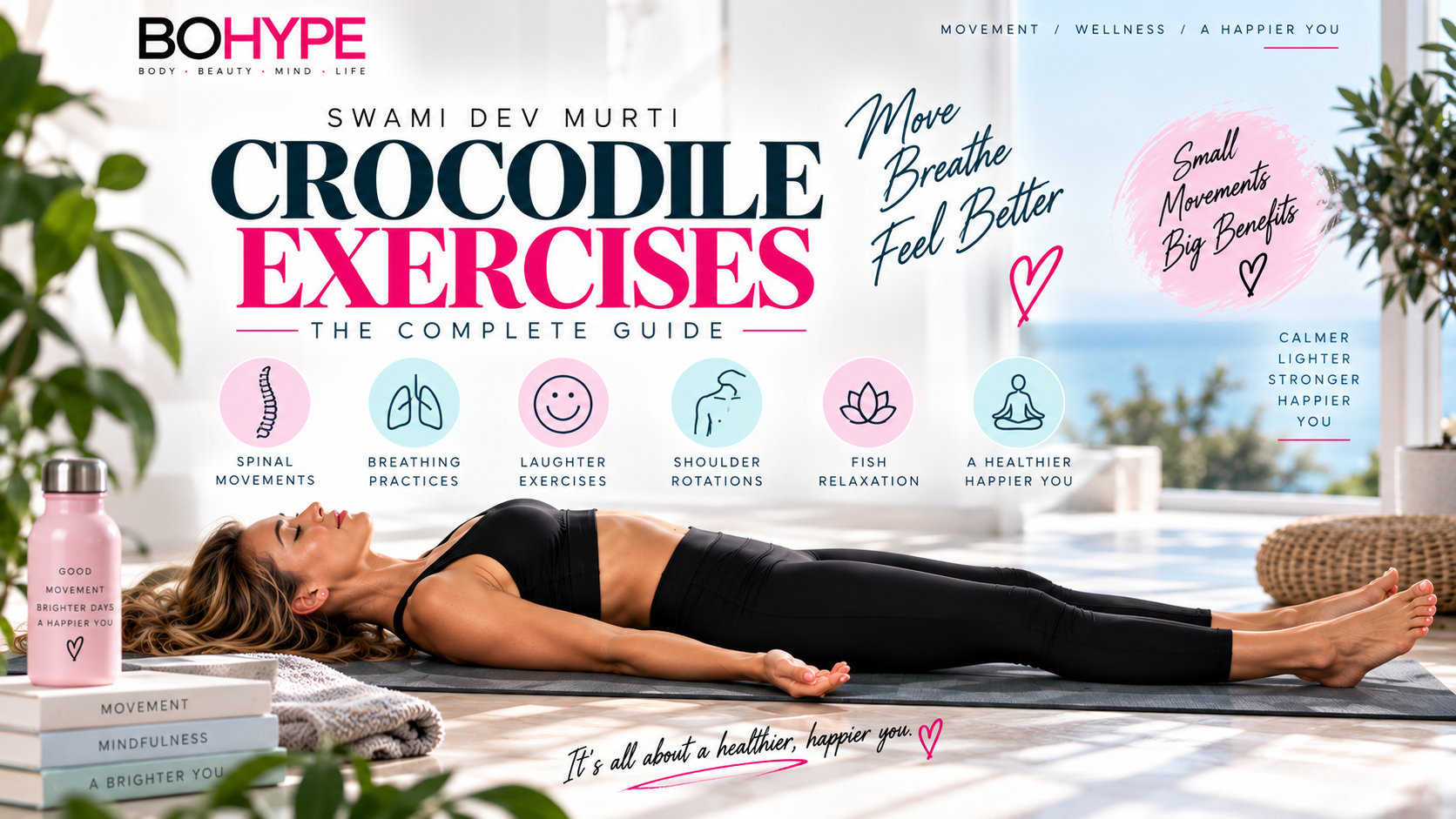
The unusual yoga practice built around twisting, movement and the spine
There are some yoga practices that look beautiful.
Others look mysterious.
And then there are the exercises created by Swami Dev Murti — movements that look almost animal-like, unconventional and surprisingly simple.
Known as the Crocodile Exercises, this system was developed by Swami Dev Murti as a distinctive approach to spinal movement. The Yoga Centre dedicated to his teachings describes different courses performed from positions including lying on the stomach, lying on the back, lying on the side, semi-bridge and sitting.
The original centre material presents twelve core exercises, with several variations within the sequence.
And there is something fascinating about them:
They don’t look like a conventional workout.
They look like a conversation between the body and the floor.
Why are they called “Crocodile Exercises”?
According to the tradition surrounding Swami Dev Murti, the movements were inspired partly by observing animals and the way they move their spines.
The central idea is rotational movement.
Instead of keeping the body rigid and moving only one joint at a time, the exercises create coordinated movements involving the legs, pelvis, torso, shoulders and head.
The result is a kind of spiral movement through the body.
The official Swami Dev Murti material describes the exercises as particularly concerned with the spine and movement of the body around it.
Before you begin
The original instructions include breath-holding techniques for healthy, well-conditioned practitioners, while specifically advising older people, people who are not in good condition, or people with health problems not to hold their breath.
For a modern general audience, the safest approach is:
Don’t force the twist.
Don’t force your breathing.
Don’t exercise through pain.
If you have a spinal condition, recent injury, significant joint problems, dizziness, or another medical issue, obtain appropriate professional advice before trying unfamiliar movements.
The descriptions below are educational and are not a substitute for instruction from a qualified teacher.
The 12 Crocodile Exercises
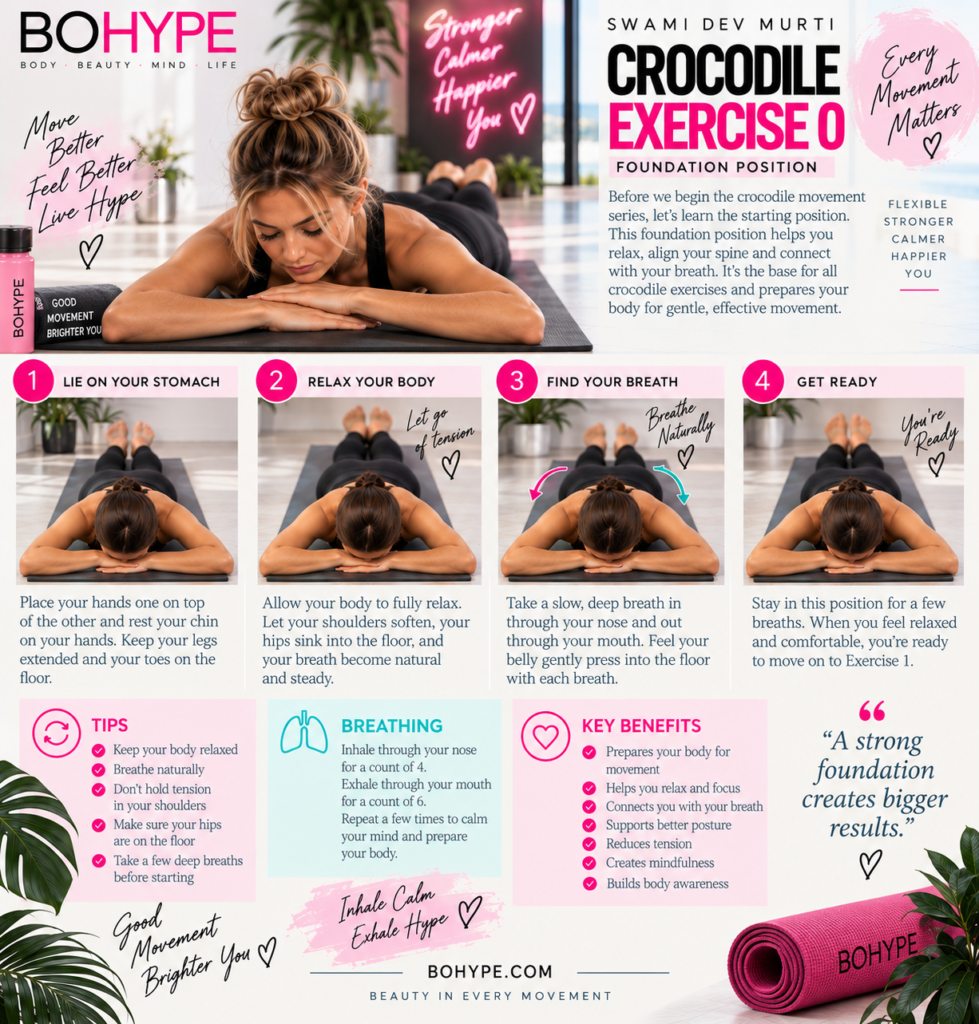
0. The basic crocodile twist
The sequence begins with the body lying on the stomach.
The hands are positioned underneath the head, with the chin resting against the hands. The legs are extended, with the toes contacting the floor.
The movement is a gentle rotational twist:
head moves one way → heels move the opposite way
Then return through the centre and repeat on the other side.
The important feature is the opposing movement of the upper and lower body.
The official instructions describe this as the basic starting movement for the stomach sequence.
1. Right leg crossed over left
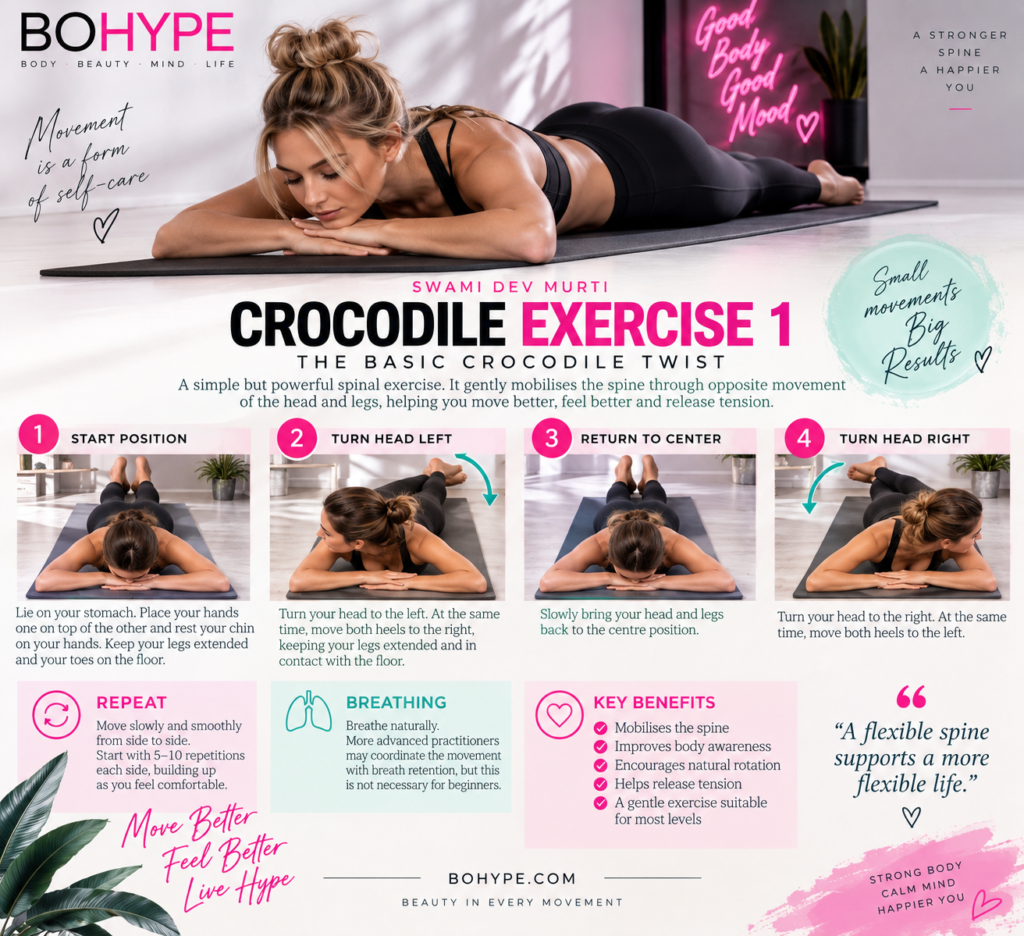
From the basic position, cross the right leg over the left.
The body then rotates from side to side while maintaining the basic upper-body position.
The movement creates a stronger relationship between the position of the legs and the rotation of the torso.
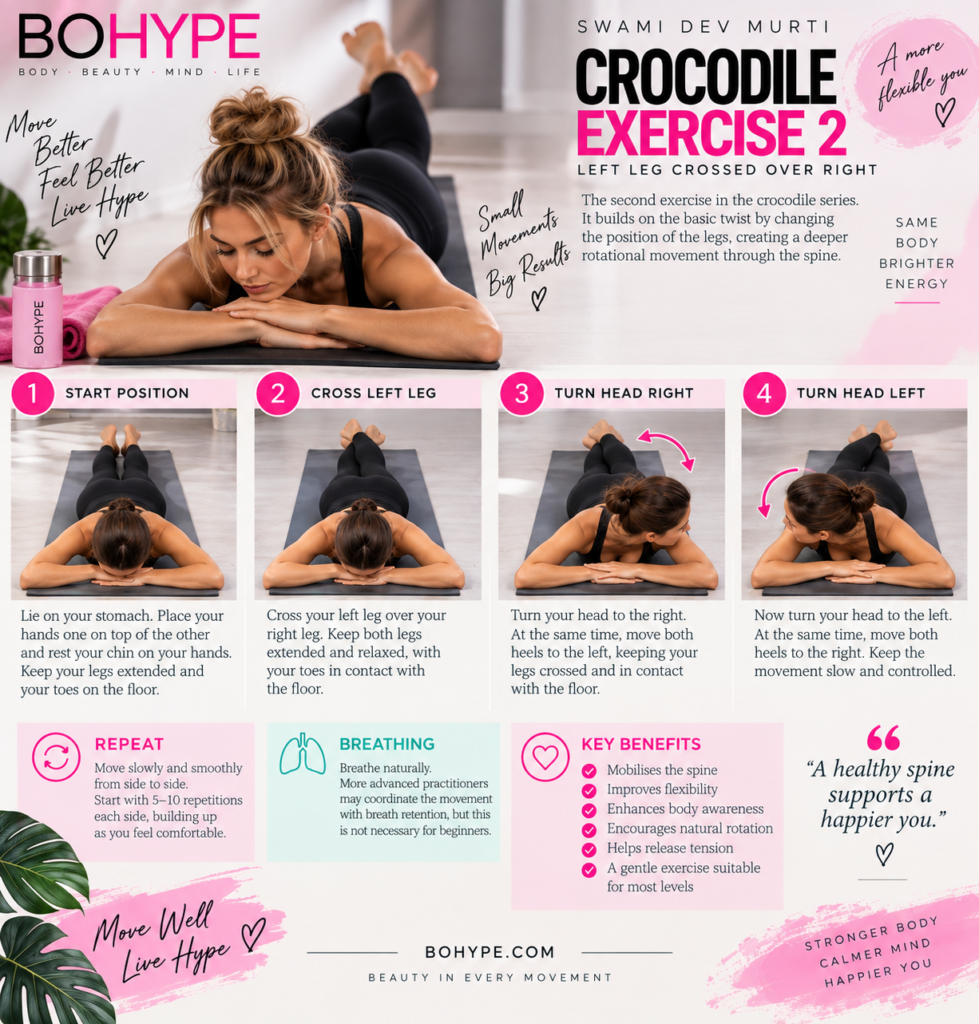
2. Left leg crossed over right
Exercise 2 reverses Exercise 1.
The left leg crosses over the right and the twisting movement is repeated.
This symmetry is important: both sides of the body are given the opportunity to perform the movement.
Think less about how far you can twist and more about making the movement smooth.
3. Achilles connection — first variation
The right foot catches the left Achilles tendon while both legs remain extended.
The head moves to one side while the legs move toward the opposite side.
This produces a more pronounced spiral through the body.
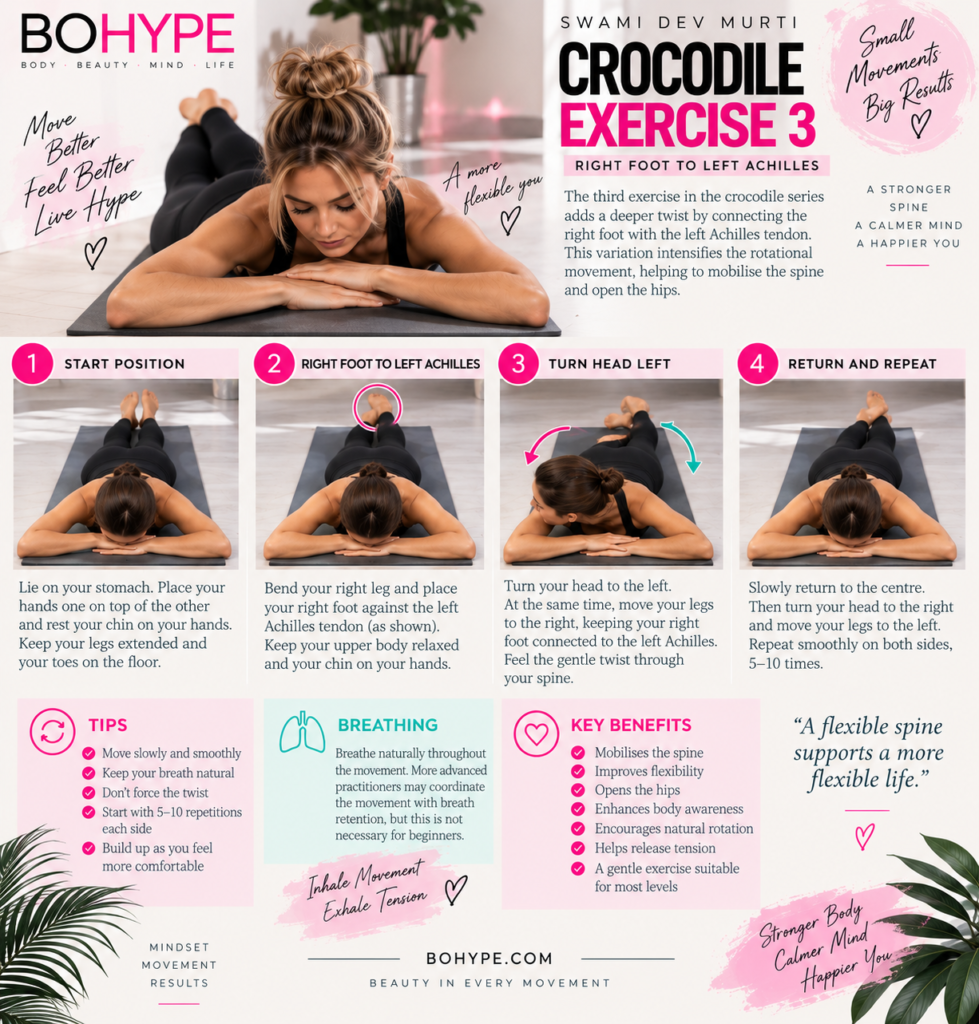
4. Achilles connection — opposite side
Exercise 4 reverses the leg configuration of Exercise 3.
The toes of the opposite foot connect with the other Achilles tendon and the rotational movement is repeated.
These two exercises demonstrate one of the central characteristics of the system:
changing the relationship between the legs changes the rotational pattern of the entire body.
The official instructions describe Exercises 1–4 in this sequence.

5. Bent-leg twist
Now the exercise becomes more complex.
One knee is positioned over the other, with the upper lower-leg segment raised approximately vertically.
The opposite leg remains extended.
The body rotates so that the raised leg moves toward the floor on one side while the head moves in the opposite direction.
Then return and repeat.
This is one of the movements that makes the Crocodile system particularly distinctive.

6. The opposite bent-leg twist
Exercise 6 mirrors Exercise 5.
The opposite leg is placed on top and the movement is performed on the other side.
Again, symmetry is built into the sequence.

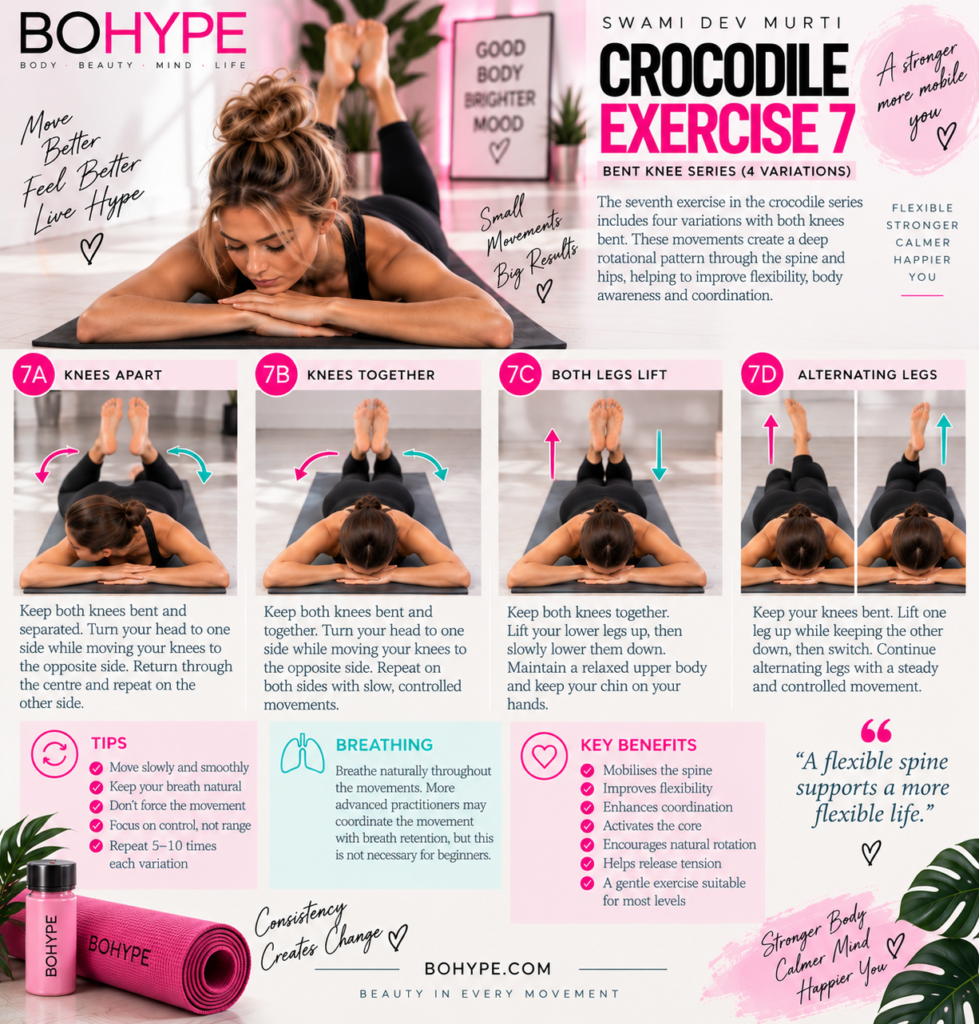
7. The bent-knee series
Exercise 7 actually contains several variations.
7A — knees apart
Both knees are bent and separated.
The head moves in one direction while the legs move in the opposite direction.
The movement creates a larger rotational pattern through the pelvis and spine.
7B — knees together
The same basic movement is performed with the knees and feet together.
This changes the mechanics of the movement and requires greater coordination.
7C — both legs together
The legs are raised and lowered by bending and extending the knees together.
7D — alternating legs
The same action is performed one leg after the other rather than simultaneously.
The official Swami Dev Murti instructions list these as 7A through 7D.
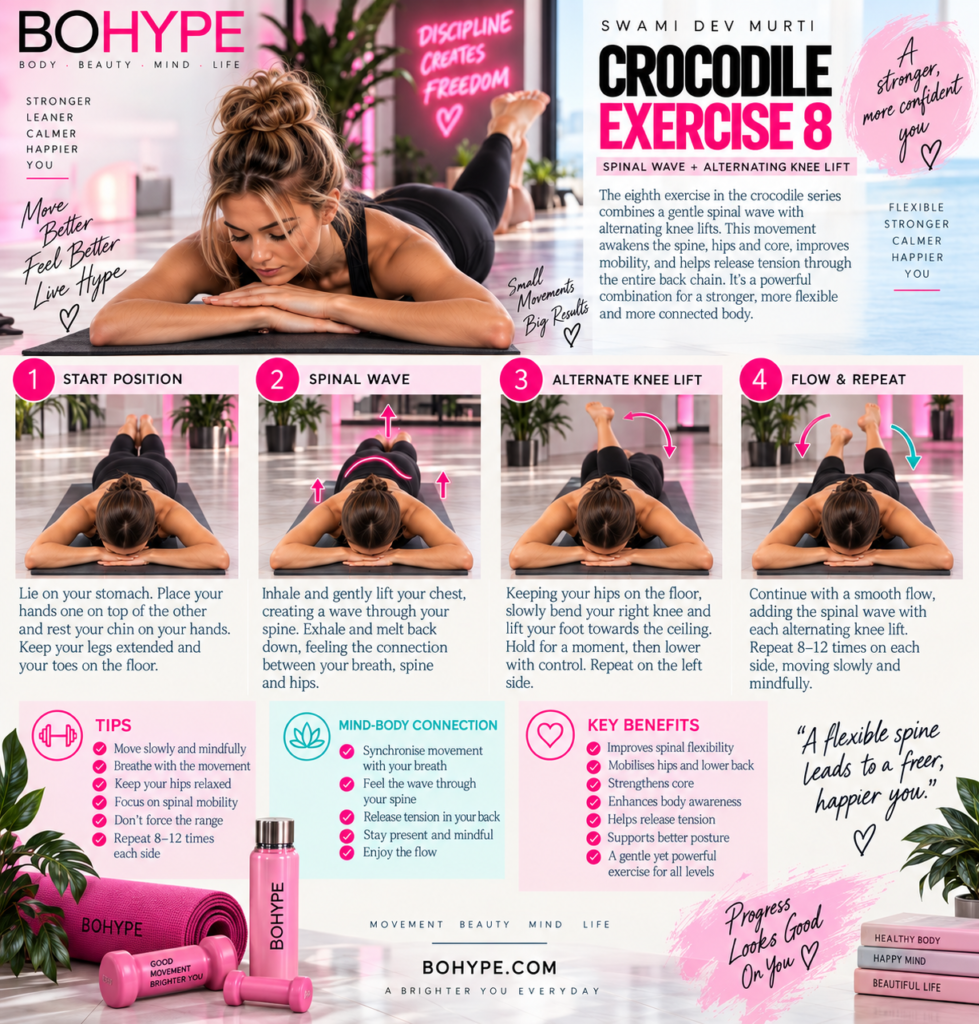
8. The rocking crocodile
This is one of the most unusual parts of the sequence.
8A — side-to-side rocking
The knees bend so that the feet move toward the buttocks.
The arms reach toward the feet, and the practitioner attempts to hold the corresponding feet.
The body then rocks from side to side.
The head moves in the opposite direction to the body.
8B — forward-and-back rocking
The same basic setup is used, but the rocking movement changes direction:
forward → backward → forward → backward
The official instructions include both variations.
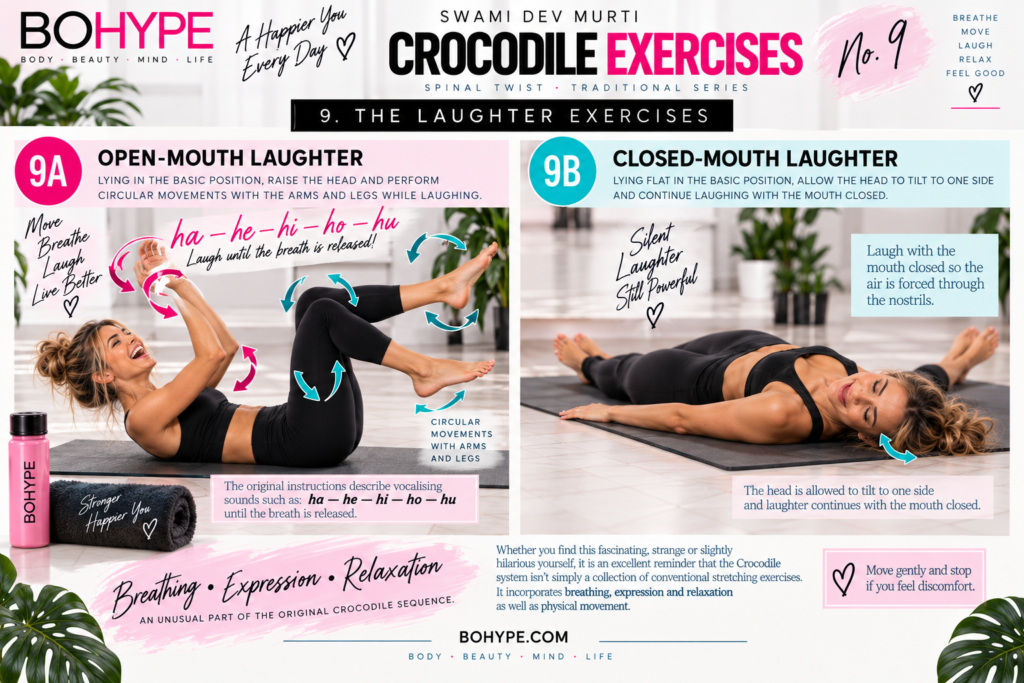
9. The laughter exercises
This is where the system becomes particularly unusual.
9A — open-mouth laughter
Lying in the basic position, the practitioner raises the head and performs circular movements with the arms and legs while laughing.
The original instructions describe vocalising sounds such as:
ha — he — hi — ho — hu
until the breath is released.
9B — closed-mouth laughter
The head is allowed to tilt to one side and laughter continues with the mouth closed.
Whether you find this fascinating, strange or slightly hilarious yourself, it is an excellent reminder that the Crocodile system isn’t simply a collection of conventional stretching exercises.
It incorporates breathing, expression and relaxation as well as physical movement.
The laughter variations are explicitly included in the original published sequence.
10. The opposite-arm-and-leg stretch
Now lie on the stomach with the arms extended overhead and the legs straight.
Reach the right arm and right leg away from the body.
Then repeat with the left arm and left leg.
The emphasis is on lengthening — reaching away rather than simply lifting.
The official instructions include this as Exercise 10.

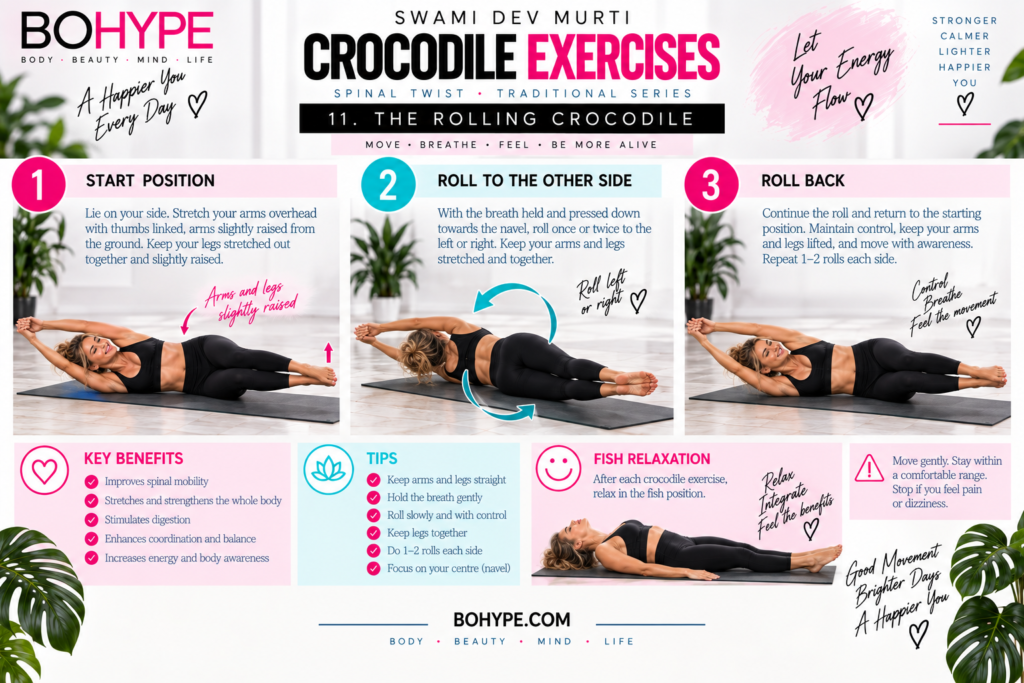
11. The rolling crocodile
Lie in the basic position with the arms extended overhead.
The thumbs are connected and the palms are together.
Keep the legs together.
Then roll the body:
right → centre → left
The movement is essentially a controlled whole-body roll.
Rather than isolating one joint, the body moves as a coordinated unit.
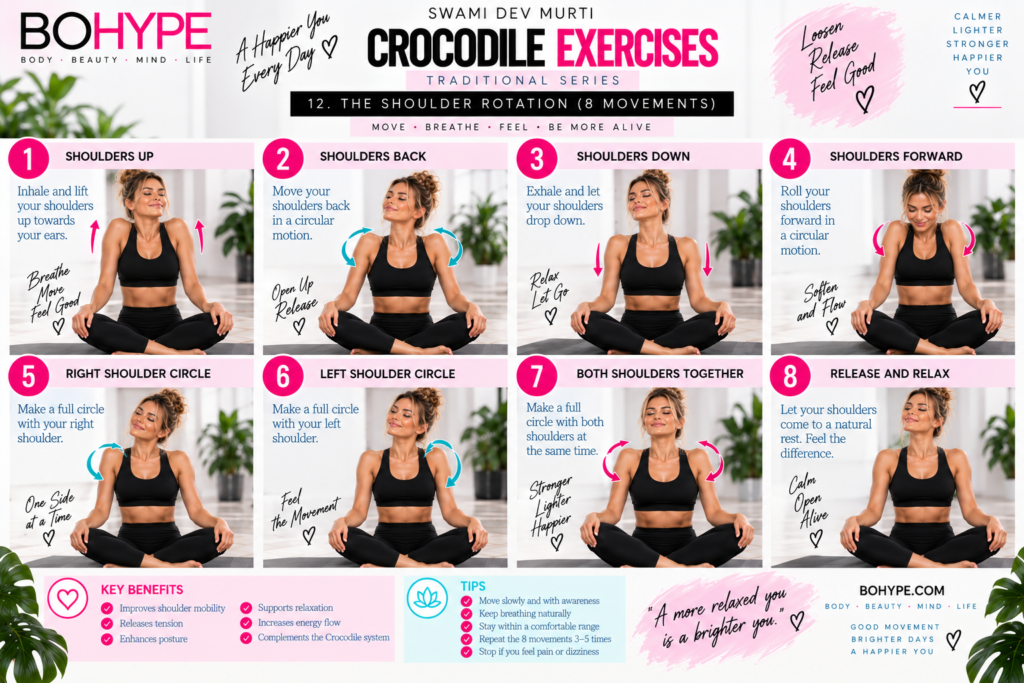
12. The seated shoulder sequence
The final exercise is different.
Instead of lying down, sit cross-legged or in Lotus position.
This is also the exercise in which the original instructions use breath retention in the chest rather than the abdominal breathing described for some of the earlier movements.
The hands rest gently on the knees while the shoulders move through a series of patterns.
Movement 1
Right shoulder forward while the left shoulder moves backward.
Movement 2
Reverse the direction.
Movement 3
Both shoulders rotate forward.
Movement 4
Both shoulders rotate backward.
Movement 5
Both shoulders move forward and then backward.
Movement 6
Lift both shoulders toward the ears, then lower them.
Movement 7
Right shoulder forward and left shoulder backward — then reverse.
Movement 8
Right shoulder rises while left shoulder lowers — then reverse.
Throughout the sequence, the head remains still and faces forward.
The official instructions state that this shoulder sequence is retained throughout the different courses and series.
The “Fish Relaxation”
There is another important part of the practice:
relaxation between exercises.
The Swami Dev Murti system calls this “Fish Relaxation.”
The practitioner lies down and allows the body to relax after the preceding movement.
The idea is simple:
move → release → move → release.
The official centre states that the different Crocodile courses begin with this relaxation technique and that relaxation is performed between exercises.
That rhythm is actually one of the most interesting things about the system.
The goal isn’t continuous muscular effort.
It alternates movement with release.

There is more than one Crocodile sequence
The twelve exercises above aren’t the entire universe of Swami Dev Murti’s system.
The Yoga Centre describes eight different courses, based on different starting positions, and says that a ninth course was later added using a seated position.
The centre identifies the first two courses — performed lying on the stomach and back — as particularly important and accessible, alongside the newer seated course.
Its programme also describes instruction in crocodile exercises performed:
on the stomach
on the back
on each side
from a semi-bridge position
seated
standing
with beginner and advanced variations.
So when someone says “the Crocodile Exercises,” they may actually be referring to a much larger system than the twelve movements presented in this introductory guide.
Why people are rediscovering them
Perhaps the most interesting thing about the Crocodile Exercises is that they don’t fit neatly into modern fitness categories.
They’re not quite strength training.
They’re not conventional stretching.
They’re not cardio.
They’re not classical yoga asana in the usual sense.
They’re a system built around movement, rotation, coordination, breathing and awareness of the spine.
And that makes them particularly intriguing in an age when so many of us spend hours sitting.
The Swami Dev Murti Yoga Centre itself continues to teach the practice and publishes material connecting the exercises with both traditional yoga and contemporary scientific perspectives.
That doesn’t mean every traditional claim should automatically be treated as established medical fact.
It means the practice is worth looking at with both curiosity and critical thinking.
Could this become your 10-minute movement ritual?
You don’t necessarily need a complicated workout every day.
Sometimes the most useful thing you can do is simply get down on the floor and move.
Slowly.
Deliberately.
Without a screen.
Without counting calories.
Without trying to beat yesterday.
The Crocodile Exercises offer a fascinating reminder that the spine isn’t just something that keeps us upright.
It’s part of how we turn, reach, roll, balance and interact with the world.
And perhaps that is the real lesson hidden inside this strange old practice:
Don’t just train your body.
Learn how to move it.
 A modern safety note
Some of the traditional instructions involve breath retention and substantial spinal rotation. Those techniques should not automatically be copied by everyone.
Beginners can perform movements gently with natural breathing, without forcing range of motion or holding the breath.
Stop if you experience pain, dizziness, numbness, tingling or other concerning symptoms.
If you have an existing medical or musculoskeletal condition, seek appropriate professional guidance before attempting the full practice.
This article describes the traditional system for educational purposes; it does not claim that the exercises diagnose, treat or cure disease.
Bohype
BODY • BEAUTY • MIND • LIFE
Sometimes the oldest ideas deserve a second look.
Not because they’re automatically right.
But because they might make us ask better questions about our bodies.
Would you try the Crocodile Exercises?

