
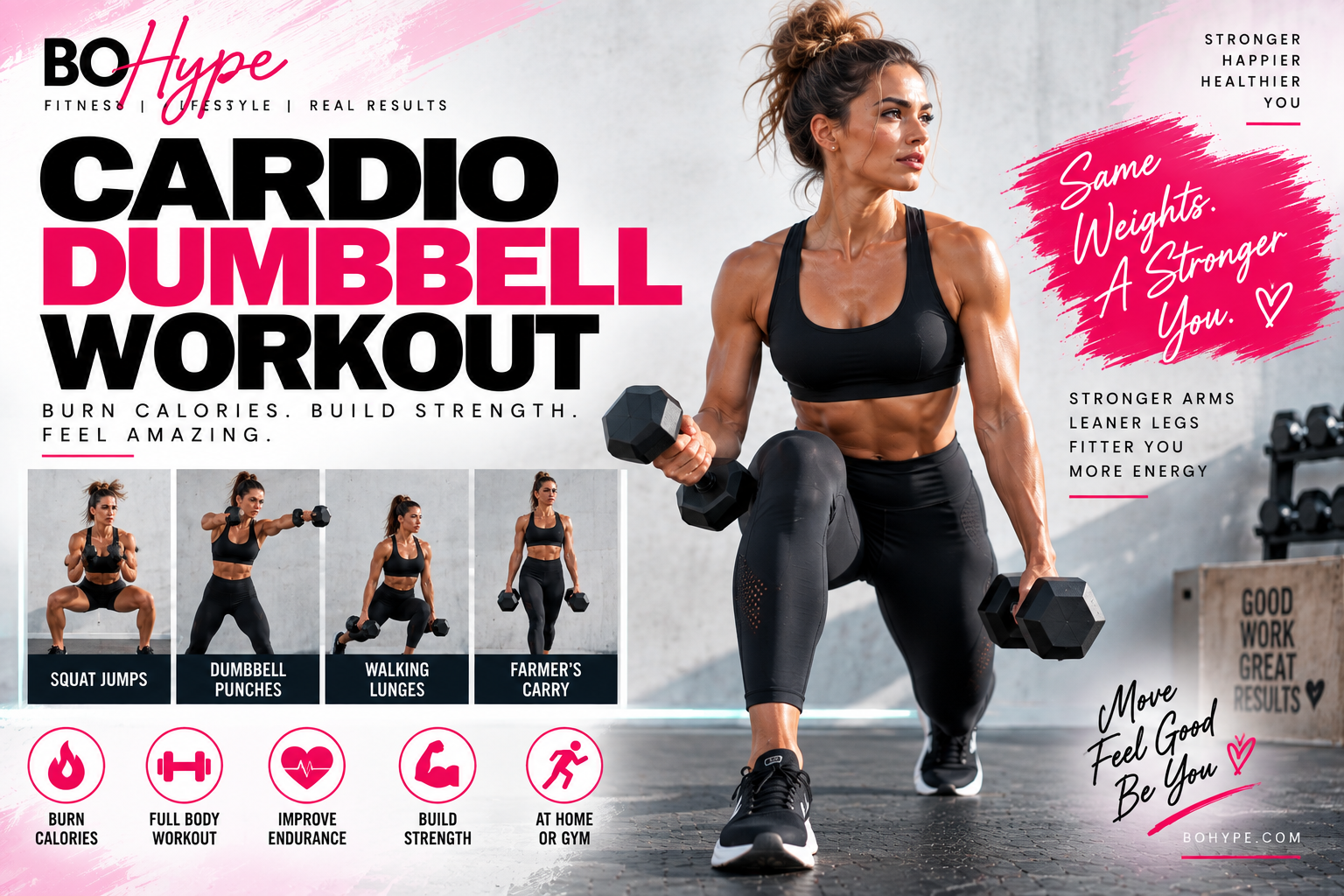
Think dumbbells are only for building muscle?
Think again.
A pair of dumbbells can turn a simple home workout into a full-body cardio and conditioning session that challenges your muscles while getting your heart rate up.
You don’t need a treadmill, elliptical, stair machine or rowing machine. With the right exercises, some floor space and a pair of dumbbells, you can create an effective cardio workout almost anywhere.
This BOHype workout combines cardio, resistance training, coordination and muscular endurance in one session.
Why Use Dumbbells for Cardio?
Traditional cardio often involves repetitive movements such as walking, running or cycling.
Dumbbell cardio adds resistance to dynamic movements, requiring your muscles to work while your heart and lungs support continuous activity.
A dumbbell cardio workout can help you:
- Raise your heart rate
- Increase muscular endurance
- Train multiple muscle groups simultaneously
- Add resistance to cardio movements
- Improve coordination and stability
- Combine strength and conditioning
- Make home workouts more challenging
- Save time by training your whole body
The goal isn’t to use the heaviest dumbbells possible.
For cardio workouts, choose a weight that allows you to keep moving while maintaining good form.
How Many Calories Does Dumbbell Cardio Burn?
The number of calories you burn depends on several factors, including body weight, exercise intensity, workout duration, pace and rest periods.
As a general estimate, a 20-minute dumbbell cardio workout may burn approximately:
| Intensity | Estimated calories — 20 minutes |
|---|---|
| Moderate | 120–170 kcal |
| High intensity | 170–250 kcal |
| Very vigorous | 200–300+ kcal |
For the BOHype 20-minute circuit below, around 150–250 kcal is a reasonable general estimate for many people.
However, these numbers are only estimates. Two people can perform exactly the same workout and burn different amounts of energy.
Your fitness tracker can also overestimate or underestimate calorie expenditure, so treat calorie numbers as a rough guide rather than an exact measurement.
And remember: the value of a workout isn’t determined only by how many calories you burn.
Strength, cardiovascular fitness, endurance and consistency matter too.
12 Dumbbell Cardio Exercises
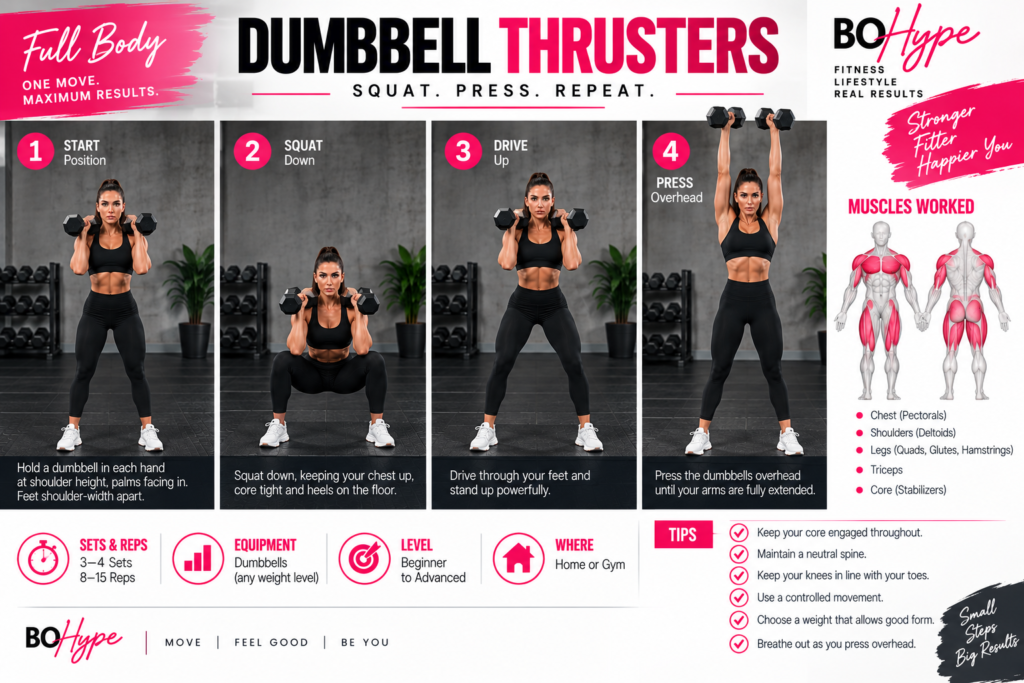
1. Dumbbell Thrusters
The dumbbell thruster combines a squat with an overhead press, making it one of the most efficient full-body exercises for a cardio circuit.
Hold a dumbbell in each hand at shoulder height.
Squat down, then drive through your feet to stand. As you stand, press the dumbbells overhead.
Return the weights to your shoulders and repeat.
Works: Quads, glutes, shoulders, triceps and core
Reps: 10–15
Tip
Keep the movement fluid:
Squat → stand → press.
2. Dumbbell High Knees
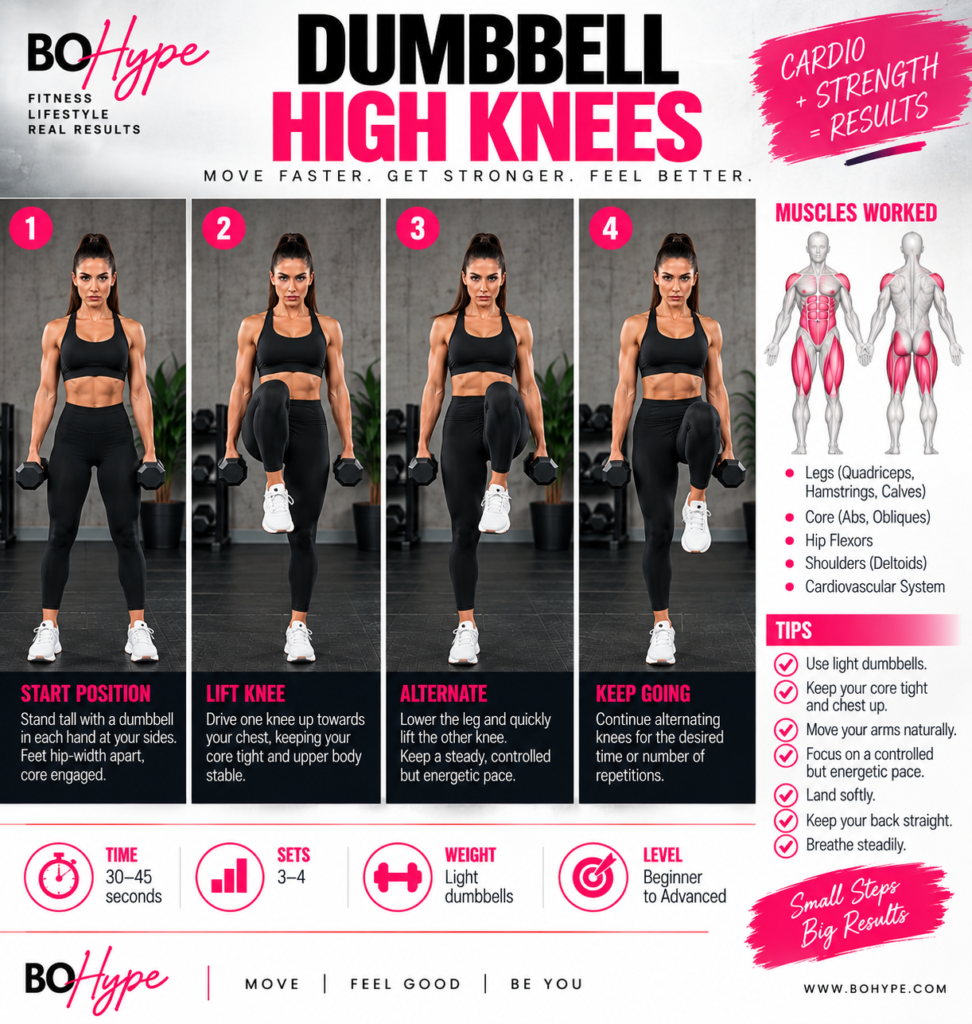
Hold very light dumbbells at your sides and alternate driving your knees upward.
Move continuously at a controlled but energetic pace.
Works: Legs, hip flexors, shoulders and core
Time: 30–45 seconds
Don’t use heavy dumbbells here. The purpose is to increase movement intensity, not maximum resistance.
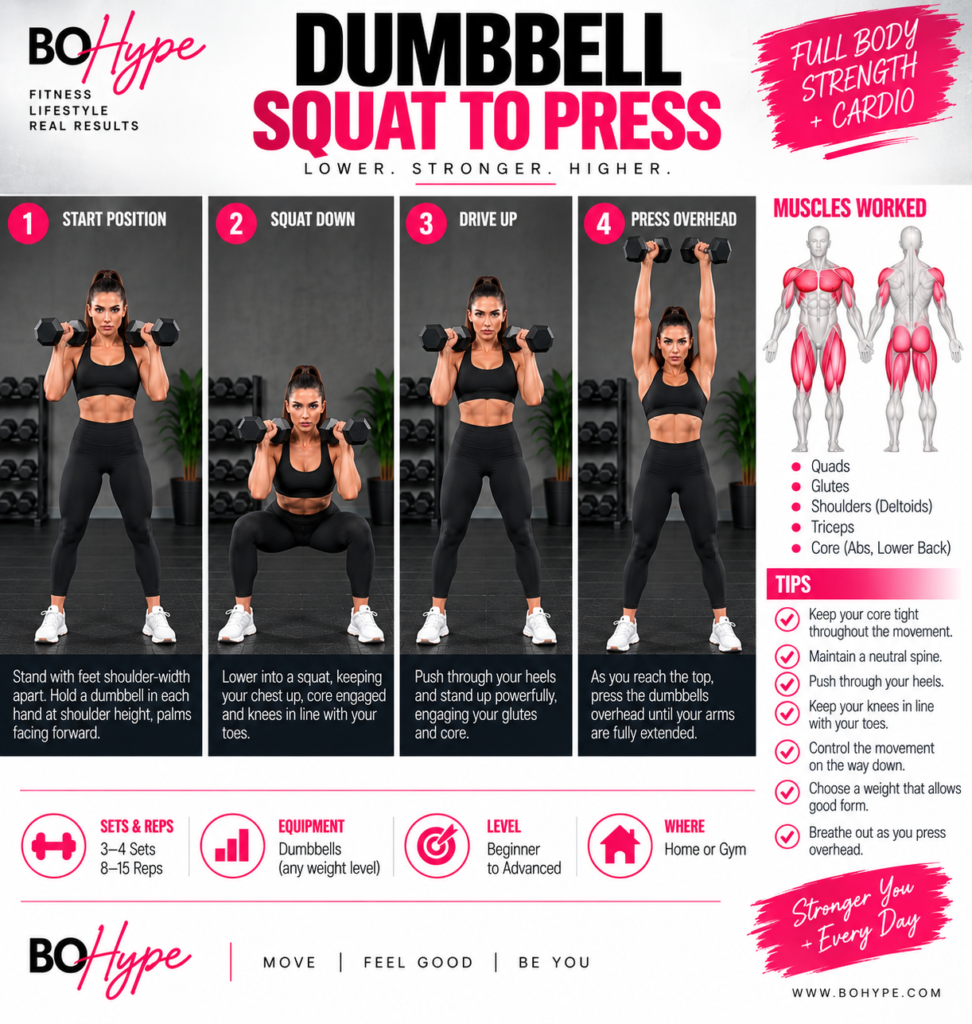
3. Dumbbell Squat to Press
Hold the dumbbells near your shoulders.
Perform a squat and, as you stand, press the dumbbells overhead.
Lower them back to your shoulders and immediately begin the next repetition.
Works: Quads, glutes, shoulders, triceps and core
Reps: 10–15
This is a simple and effective full-body movement for beginners.
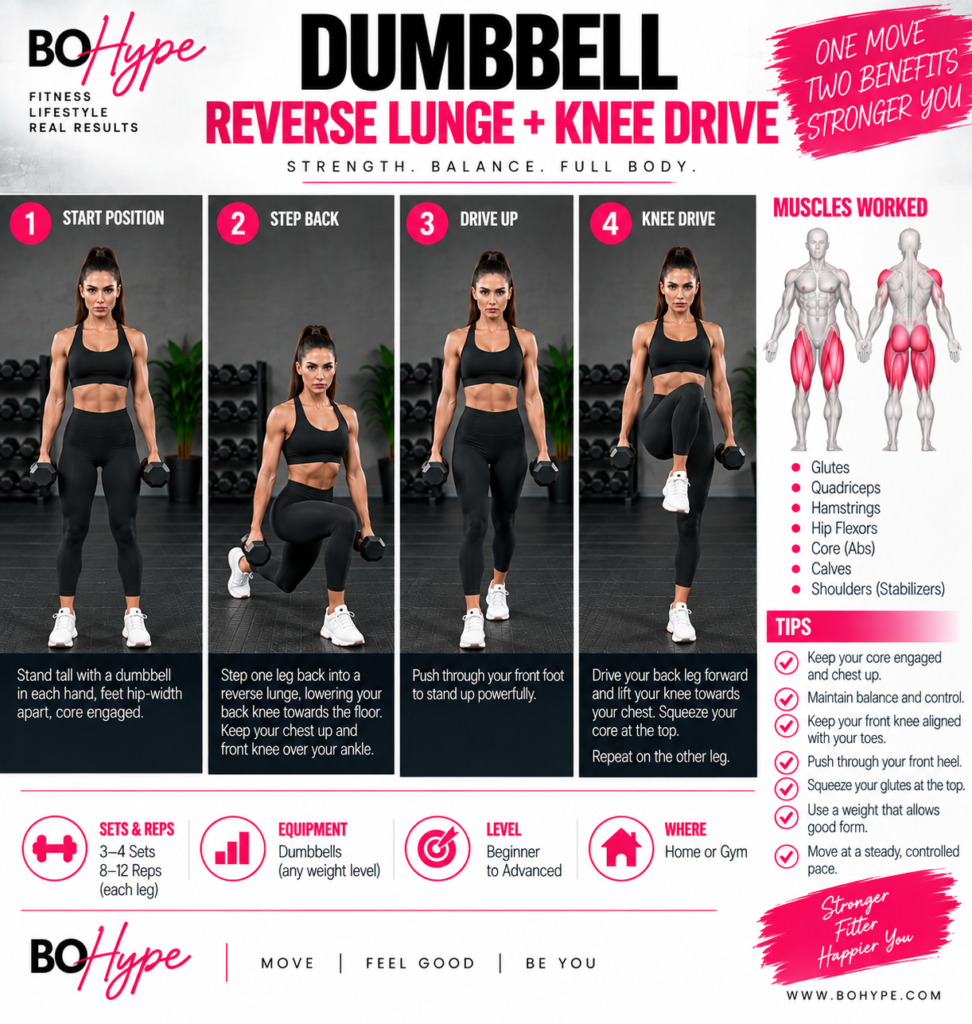
4. Dumbbell Reverse Lunge + Knee Drive
Hold the dumbbells at your sides.
Step backward into a reverse lunge. Push through your front foot to stand and drive the rear knee forward and upward.
Return to the starting position and alternate legs.
Works: Glutes, quads, hamstrings and core
Reps: 8–12 each leg
The knee drive increases the cardiovascular challenge while also requiring balance and coordination.
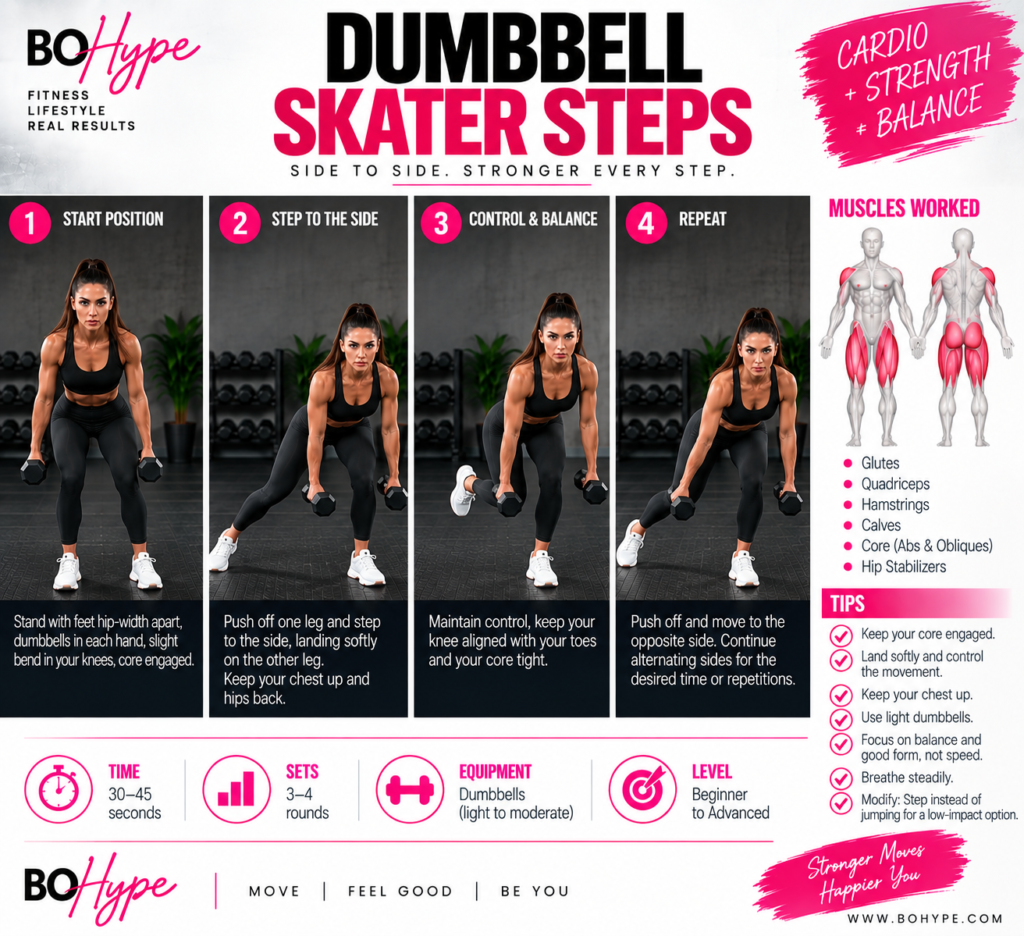
5. Dumbbell Skater Steps
Hold one light dumbbell with both hands, or use two very light dumbbells.
Move laterally from side to side, stepping or lightly hopping between sides.
Works: Glutes, legs, calves and core
Time: 30–45 seconds
Low-impact option
Skip the jumping and simply take controlled side-to-side steps.
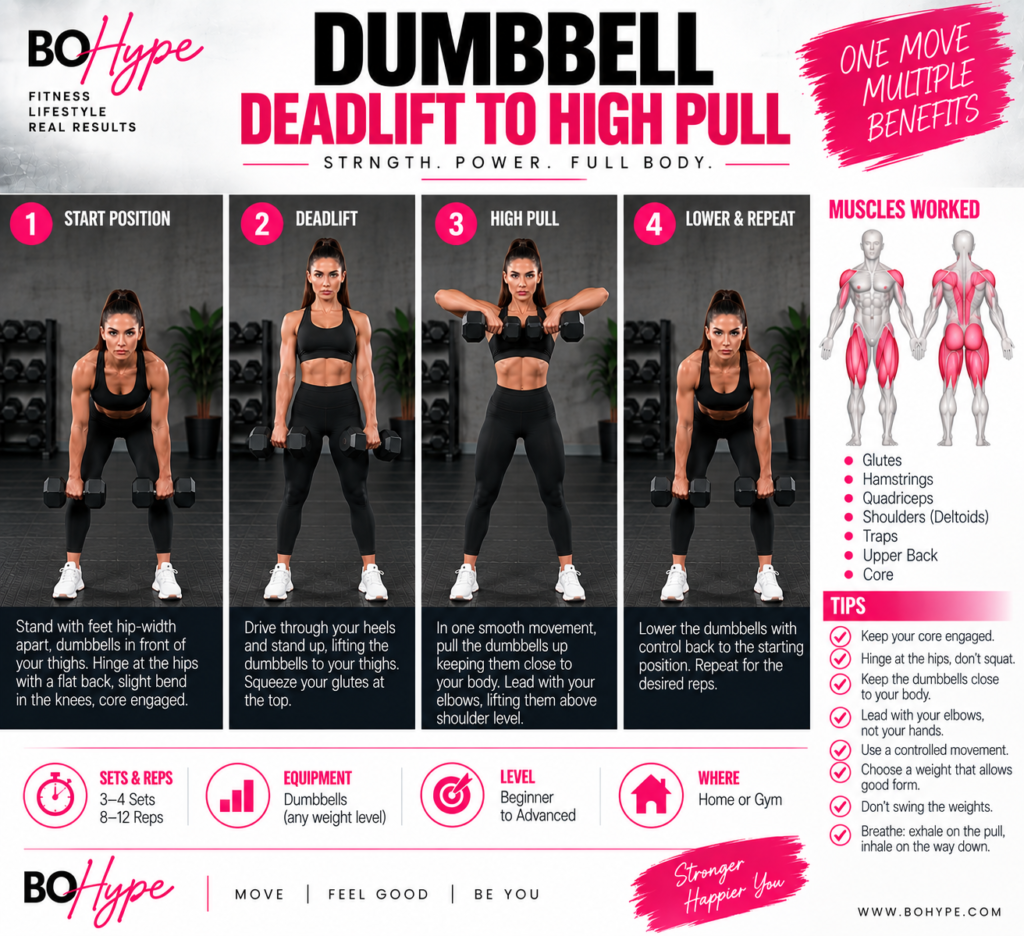
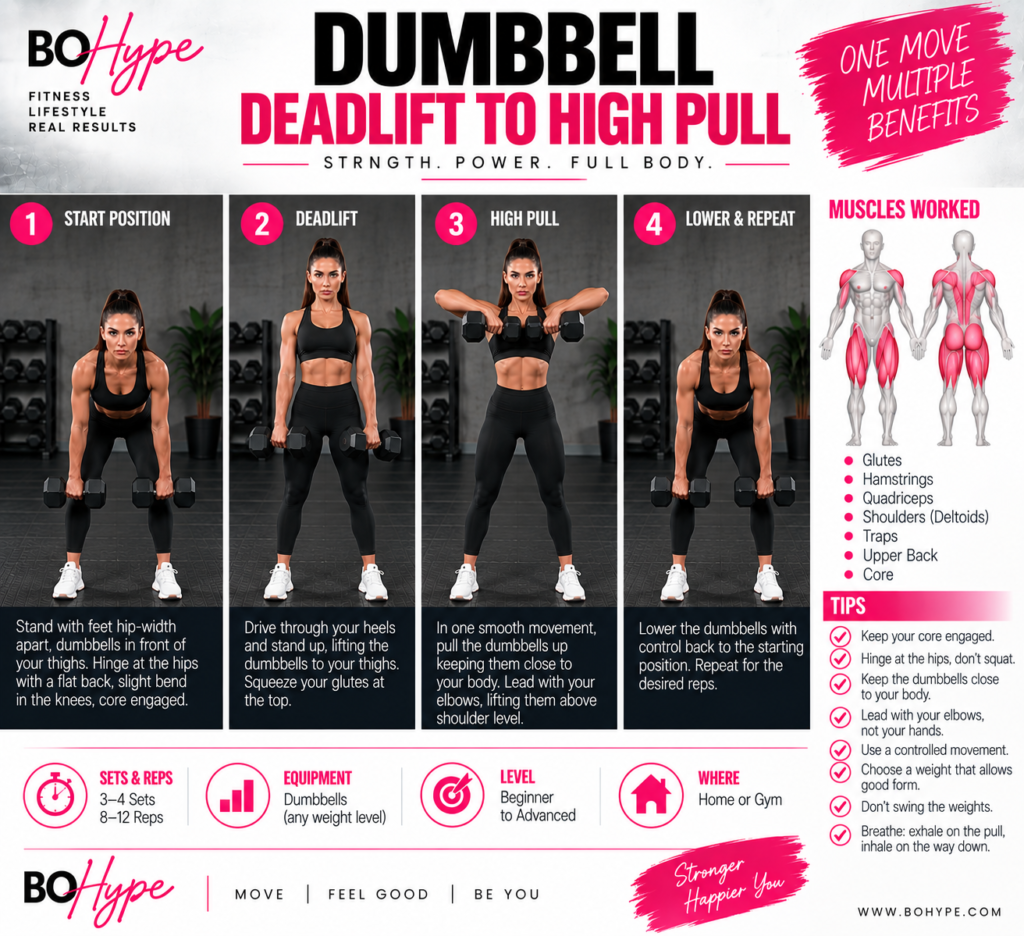
6. Dumbbell Deadlift to High Pull
Start with the dumbbells in front of your thighs.
Hinge at your hips and lower the dumbbells toward the floor.
Stand up by driving through your feet and extending your hips, then pull the dumbbells upward toward your upper chest.
Lower them and repeat.
Works: Hamstrings, glutes, traps, shoulders and back
Reps: 10–15
Keep the deadlift portion controlled and avoid using a weight that forces you to jerk the dumbbells upward.
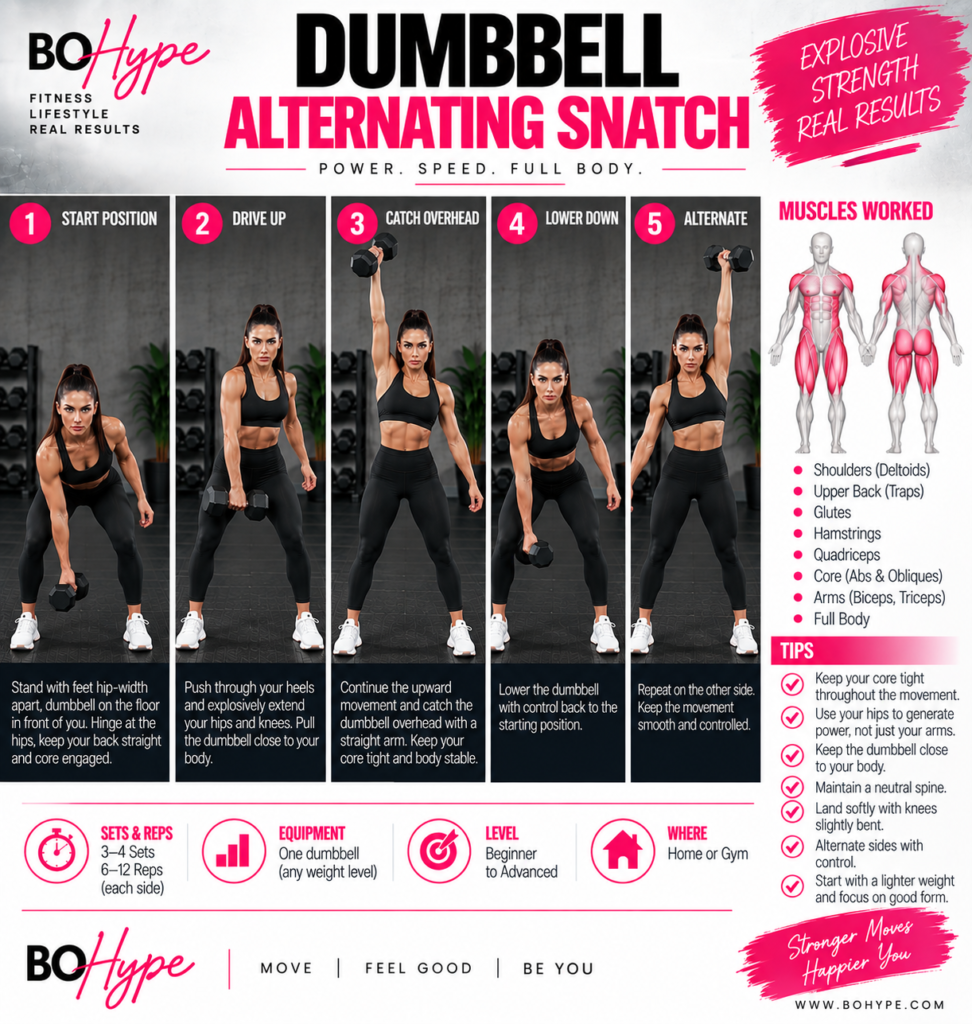
7. Dumbbell Alternating Snatch
The dumbbell snatch is a powerful full-body movement.
Place one dumbbell between your feet.
Hinge down, then drive through your legs and hips while bringing the dumbbell overhead in one smooth movement.
Lower it under control and switch arms.
Works: Glutes, hamstrings, shoulders, back and core
Reps: 8–12 each side
This is a more advanced exercise. Master the movement before increasing speed or weight.
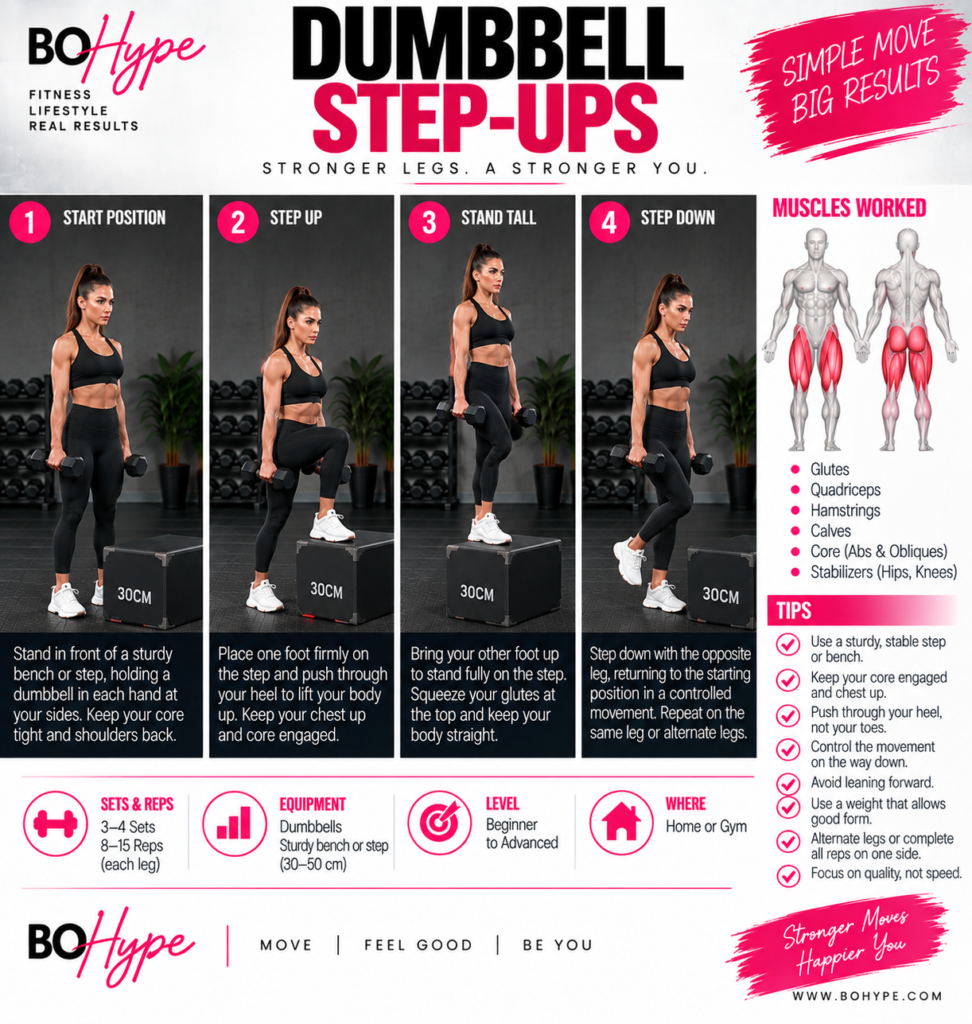
8. Dumbbell Step-Ups
Use a stable, non-slip platform or low step.
Hold the dumbbells at your sides and step up with one leg.
Bring the other leg up, then step back down and alternate sides.
Works: Quads, glutes, hamstrings and calves
Reps: 10–15 each leg
Increase the pace only when you can perform every repetition safely and under control.
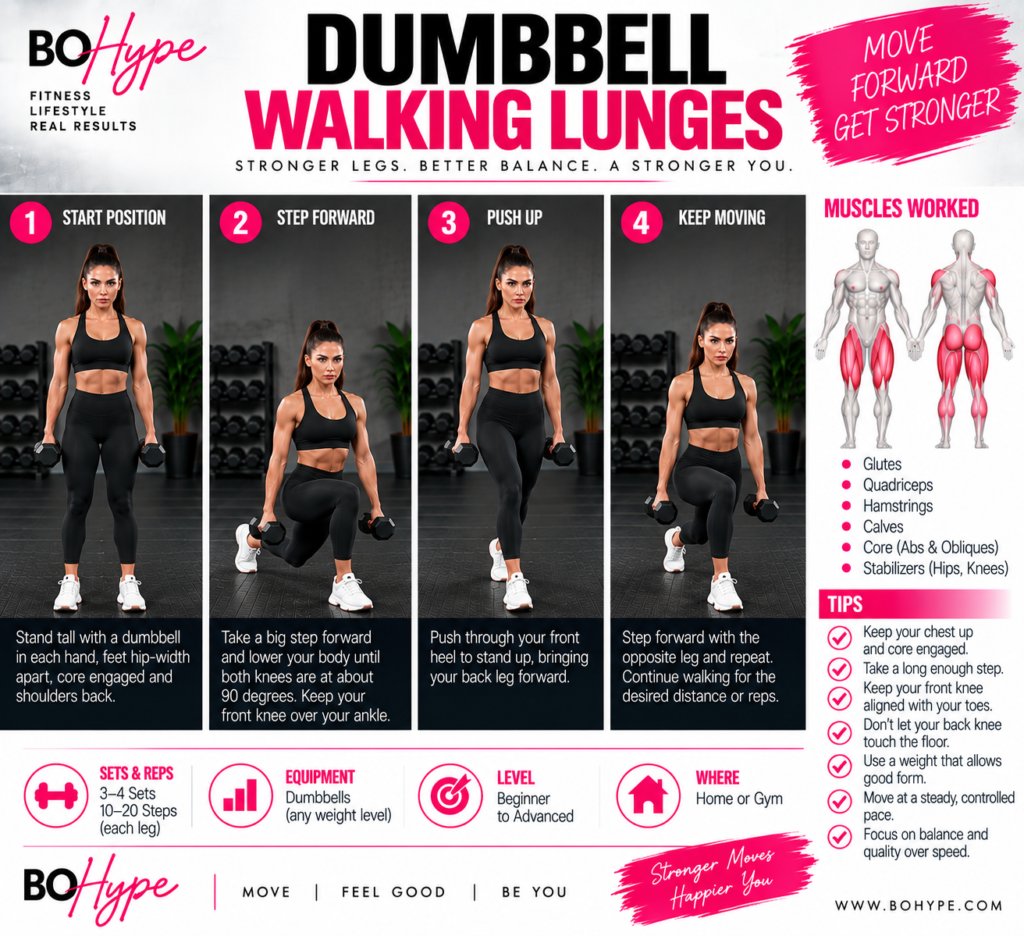
9. Dumbbell Walking Lunges
Hold a dumbbell in each hand.
Step forward into a lunge, push through the front foot and bring the rear leg forward into the next lunge.
Continue moving forward.
Works: Quads, glutes, hamstrings and calves
Reps: 10–20 total steps
If space is limited, perform alternating stationary lunges instead.
10. Dumbbell Squat Jumps
Hold very light dumbbells—or perform the exercise without weights.
Lower into a squat and jump upward.
Land softly with your knees slightly bent and prepare for the next repetition.
Works: Legs, glutes and core
Reps: 8–12
Low-impact option
Remove the dumbbells and replace the jump with a fast squat-to-stand movement or powerful calf raise.
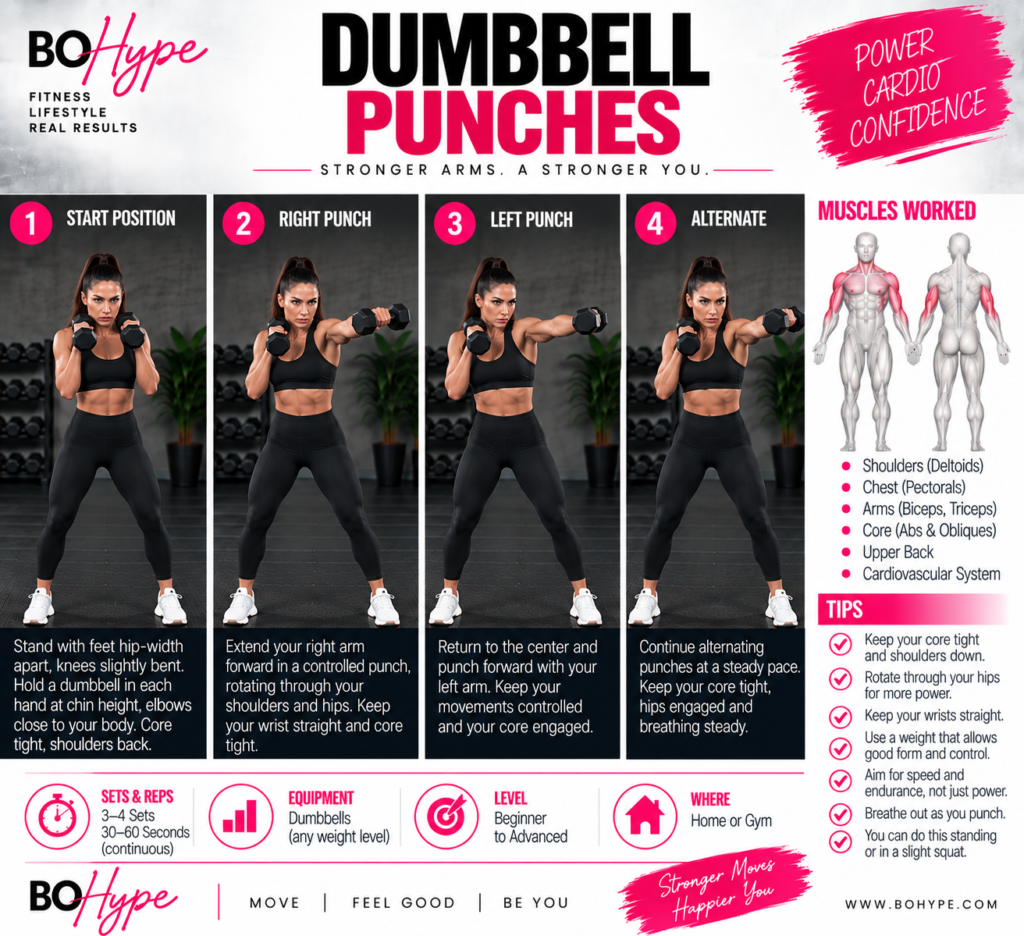
11. Dumbbell Punches
Hold very light dumbbells and alternate punching forward.
Keep your core engaged and allow your torso to rotate naturally.
Works: Shoulders, arms and core
Time: 30–45 seconds
Use extremely light weights. Heavy dumbbells aren’t necessary for this movement.
The goal is controlled speed and continuous movement.
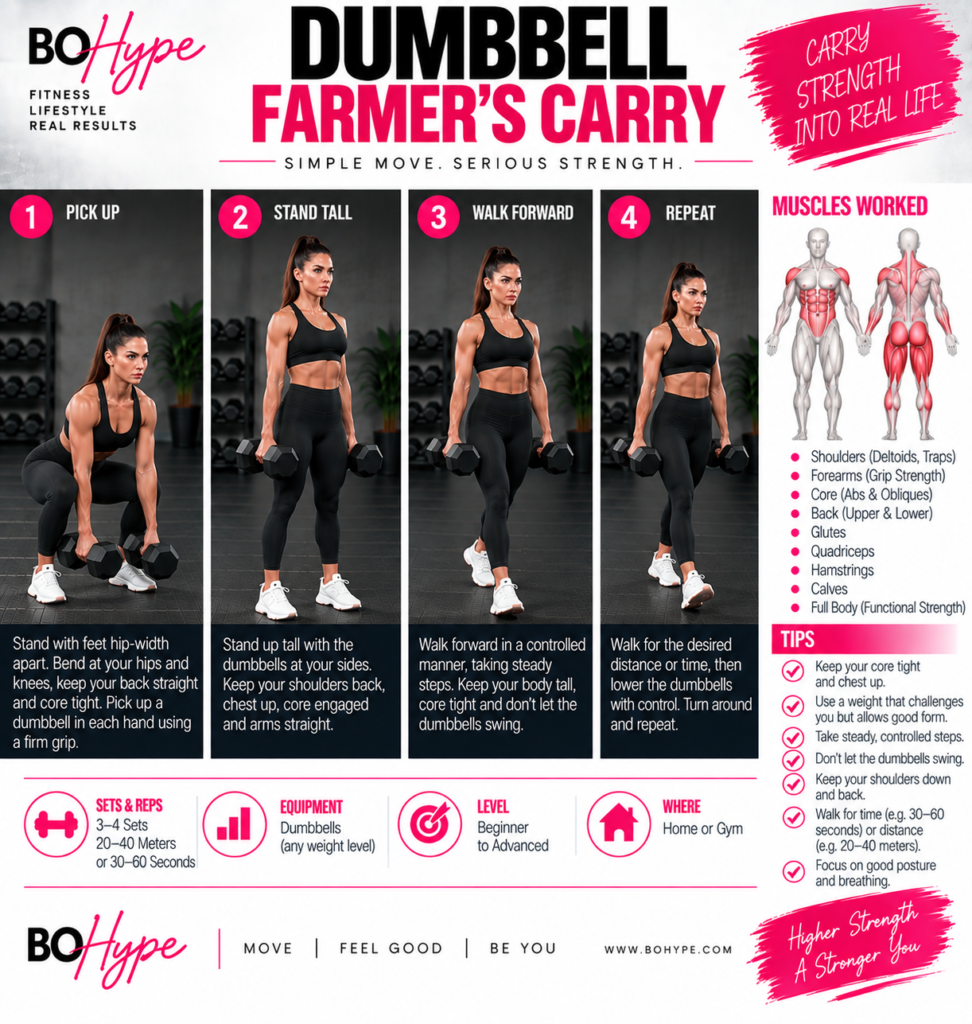
12. Dumbbell Farmer’s Carry
Sometimes the simplest exercise is one of the most challenging.
Hold a dumbbell in each hand and walk continuously while maintaining an upright posture.
Works: Grip, traps, shoulders, core and legs
Time: 30–60 seconds
Keep your shoulders relaxed rather than shrugging them toward your ears.
Your BOHype 20-Minute Dumbbell Cardio Workout
You don’t need to perform all 12 exercises in one session.
Try this six-exercise circuit:
| Exercise | Work |
|---|---|
| Dumbbell Thrusters | 40 sec |
| Reverse Lunge + Knee Drive | 40 sec |
| Dumbbell Deadlift to High Pull | 40 sec |
| Dumbbell Step-Ups | 40 sec |
| Dumbbell Punches | 40 sec |
| Farmer’s Carry | 40 sec |
Rest: 20 seconds between exercises.
Complete 3 rounds.
This creates approximately 20 minutes of work and recovery.
If you’re a beginner, start with shorter work periods and longer rests.
How Heavy Should Your Dumbbells Be?
For cardio-style training, lighter dumbbells are usually more appropriate than very heavy weights.
Choose a weight that allows you to:
- Maintain good technique
- Keep moving continuously
- Control the dumbbells
- Complete the planned repetitions
- Recover between exercises
If your form starts to break down, reduce the weight or increase your rest period.
For jumping, punching and other fast movements, you may want to use very light dumbbells—or no dumbbells at all.
Low-Impact Dumbbell Cardio
Cardio doesn’t have to involve jumping.
You can make this workout much more joint-friendly by changing a few exercises.
Instead of squat jumps:
Fast bodyweight squats
Instead of skater jumps:
Side-to-side steps
Instead of high knees:
Marching high knees
Instead of jumping lunges:
Reverse lunges
Instead of fast step-ups:
Controlled step-ups
You can still increase your heart rate without repeatedly jumping.
How to Make Dumbbell Cardio Harder
You don’t always need heavier weights to make a workout more challenging.
Try:
Increase your work time
Move from 30 seconds to 40 or 45 seconds.
Reduce your rest
Gradually shorten recovery periods.
Add another round
Three rounds can eventually become four.
Increase repetitions
Perform more controlled repetitions within the same time.
Improve your range of motion
Work through a comfortable, controlled range.
Increase the dumbbell weight
Only do this when you can maintain excellent form with your current weight.
Dumbbell Cardio vs. Traditional Cardio
You don’t have to choose between them.
Walking, running, cycling and other forms of cardiovascular exercise can be excellent ways to improve cardiovascular fitness.
Dumbbell circuits provide something different: they combine resistance training with continuous movement.
That makes them particularly useful when you want to train several components of fitness in a relatively short workout.
You could also combine both approaches—for example, walking on some days and doing dumbbell cardio on others.
How Often Can You Do Dumbbell Cardio?
Your training frequency should depend on the intensity of the workout and how well you recover.
For a challenging full-body dumbbell cardio session, 2–3 sessions per week can be a practical starting point, with recovery days or easier activity between harder sessions.
You don’t need to destroy yourself every workout.
Consistency beats doing one extremely difficult session and then stopping for a week.
Safety First
Dumbbell cardio can become demanding very quickly.
Before starting:
- Warm up for several minutes
- Clear enough space around you
- Check that dumbbells are secure and stable
- Use a non-slip surface
- Choose an appropriate weight
- Start at a manageable intensity
- Keep your technique controlled
Stop if you experience unusual pain, dizziness, chest pain or significant shortness of breath.
If jumping doesn’t feel comfortable, choose the low-impact alternatives.
The BOHype 20-Minute Challenge
Want to keep it simple?
Grab your dumbbells.
Set a timer.
Perform:
40 seconds work
20 seconds rest
Repeat the six exercises for 3 rounds.
That’s it.
Depending on your body size, intensity and rest periods, you may burn roughly 150–250 kcal, but the real goal is bigger than the calorie number:
Move your body. Challenge your muscles. Raise your heart rate. Build consistency.
The Bottom Line
You don’t need a treadmill.
You don’t need an elliptical.
You don’t need a stair machine.
You don’t even need a gym.
A pair of dumbbells can turn your living room into a surprisingly effective cardio and conditioning space.
Use lighter weights for fast movements, focus on good form and gradually increase the challenge as your fitness improves.
And remember:
The goal isn’t to burn as many calories as possible.
It’s to build a body that is stronger, fitter and more capable.
BOHype
MOVE | FEEL GOOD | BE YOU

